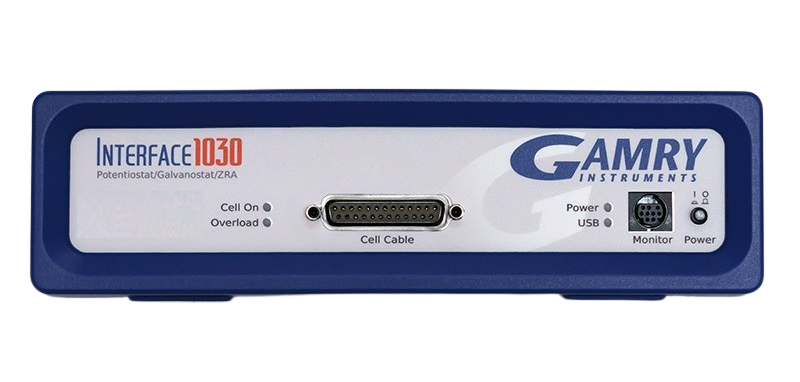
Interface 1030E
The Interface 1030E can perform a variety of electrochemical measurements, including electrochemical impedance techniques. For example: physical electrochemistry, electrochemical corrosion, battery testing, fuel cell testing, solar cell testing and sensor development and other applications.
Electrochemical Impedance Spectroscopy

Flexible configuration
The Interface 1030E can be used for single-channel, dual-channel, or a combination of multiple channels. GAMRY provides flexible configuration.
More capabilities of the Interface 1030E are given below. Each bullet point represents a performance.
- Physical Electrochemistry - Cyclic voltammetry, linear sweep voltammetry, chronoamperometry, chronopotentiometry, chrono-coulomb method, multi-step chronoamperometry, and multi-step chronopotentiometry techniques.
- Pulse Voltammetry – Differential pulse voltammetry, conventional pulse voltammetry, reverse pulse voltammetry, Osteryoung square wave voltammetry and related techniques such as anodic stripping voltammetry.
- DC Corrosion - Run standard DC corrosion tests such as polarization resistance, potential, cyclic polarization and galvanic corrosion, etc.
- Electrochemical Energy Devices - Test cells, capacitors, and fuel cell single cells and stacks. It includes typical test techniques such as charge, discharge, cyclic charge-discharge constant, constant potential, constant current, self-discharge, leakage rate and read potential.
- Electrochemical Signal Analyzer - Software for acquisition and analysis of time-correlated electrochemical noise signals. Continuous monitoring of voltage and current at rates from 0.1 Hz to 1 kHz. Full-featured analysis tools such as statistical analysis, trend, impedance spectroscopy, and histogram analysis.
- Electrochemical Frequency Modulation - A Nondestructive Corrosion Rate Measurement Method. With this technique, the corrosion rate is directly measured without the Tafel constant. In addition, the technique can determine the Tafel constant and provide parameters related to pitting.
- Critical Pitting Temperature - Controls the Gamry potentiostat, TDC4 temperature controller, and related accessories to automatically measure the critical pitting temperature of materials.
- Electrochemical Noise - Electrochemical noise testing is a more general technique. It is compatible with the ECM8 multiplexer software package for electrochemical noise measurements.
- Electrochemical Impedance - In addition to single frequency Mott-Schottky measurements, also includes potentiostatic, galvanostatic and hybrid impedance measurements. These include a unique multi-wave weighting technique to improve the signal-to-noise ratio. In terms of analysis, the equivalent circuit diagram is used to fit the data, the Kramers-Kronig transformation to evaluate the data and a graphical editor, etc. The software includes an impedance simulation section.
- eChemAC Toolkit - Software toolkit for full control of potentiostats for impedance (EIS) measurements and EFM experiments.
other details
- 2, 3 and 4 electrode measurements
- Electrical isolation
- Floating: For autoclaves, mechanically stressed equipment or pipelines.
- portable
- The size of a chemistry textbook and weighs only 3kg. USB 2.0 connection to Windows computer.
-
Built-in EIS
- EIS measurements from 10 μHz to 2 M Hz were performed using advanced DDS.
- DSP (Digital Signal Processing) Mode
- Oversampling mode improves signal-to-noise ratio and accurate capacitance measurements.
- Oversampling mode improves signal-to-noise ratio and accurate capacitance measurements.
- The Gamry potentiostat and its control software use linear regression to accurately measure and achieve IR compensation.
- Auxiliary I/O
-
Through I/O design, control third-party equipment: realize external signal input, analog voltage output, analog current output, auxiliary A/D input and digital I/O connector.
- hedging period
Interface 1030E - Part #992-00243 (992-243)